
If you have read anything about SEO lately, you have seen the letters E-E-A-T. They come from Google’s Search Quality Rater Guidelines and describe what makes content trustworthy.
Google added “Experience” to the older E-A-T in December 2022 and was clear about one thing: “trust is the most important member of the E-E-A-T family” (Search Engine Roundtable). In 2026, with AI tools choosing which sources to quote, those trust signals matter more than ever.
Quick answer: E-E-A-T stands for Experience, Expertise, Authoritativeness and Trust. It is a framework Google’s quality raters use to judge content quality. It is not a single ranking factor, but showing real experience, named experts, a strong reputation and accurate, transparent content helps both Google and AI engines trust your pages.
In this guide
What Is E-E-A-T?
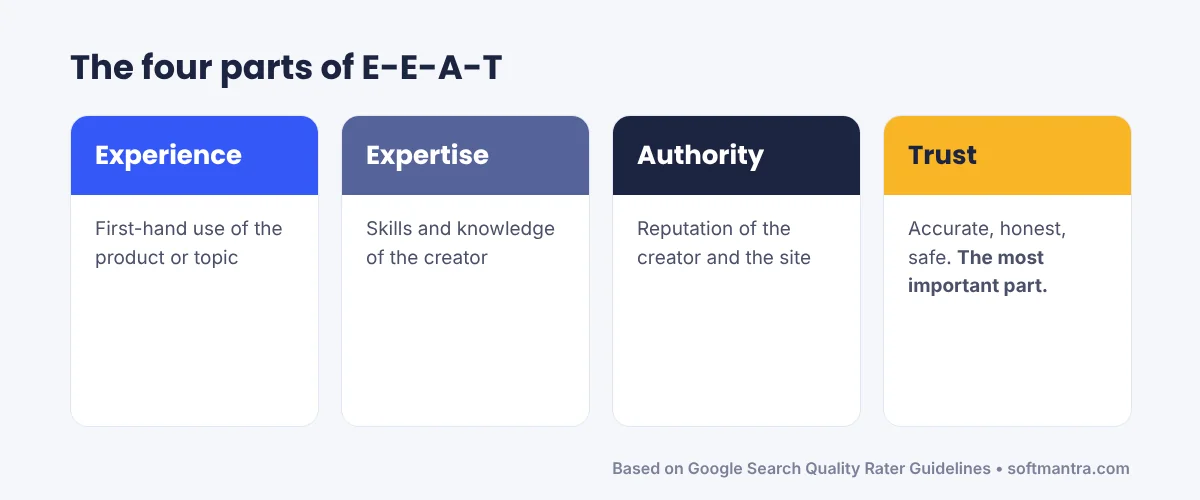
- Experience: has the creator actually used the product, visited the place or done the work?
- Expertise: does the creator have the knowledge or skills for this topic?
- Authoritativeness: is the creator or website known as a go-to source?
- Trust: is the page accurate, honest, safe and reliable? Google says untrustworthy pages have low E-E-A-T no matter how expert they seem (Search Engine Roundtable).
How Google Uses E-E-A-T
Google’s quality raters do not change rankings directly. Their ratings help Google evaluate whether its systems are working. Google’s guide to helpful content encourages creators to ask the same E-E-A-T style questions about their own pages (Google).
AI answer engines follow similar logic. Studies show they favour brands that are widely mentioned and trusted across the web, which is essentially authority and trust at scale. See how to rank in ChatGPT for the data.
How to Show Experience
- Write from real projects: “When we audited a client’s site, we found…”
- Add original photos, screenshots and results.
- Share case studies with real numbers, like our WellWith and Univest results.
How to Show Expertise
- Name the author on every article and link to a full author page, like our founder’s profile.
- List qualifications, certifications and years of experience.
- Have experts review sensitive topics such as health, finance or legal advice.
Want your site to show its expertise clearly? Our content team writes and restructures pages with real author and proof signals.
How to Build Authority
- Earn mentions and links from respected sites through PR. See our digital PR guide.
- Keep a strong Google Business Profile with genuine reviews. See our Google Business Profile checklist.
- Speak at events, write guest articles and appear on podcasts.
How to Build Trust
- Show a real address, phone number and contact page.
- Cite sources for every statistic, with links.
- Show “last updated” dates and correct errors quickly.
- Use HTTPS and keep the site secure.
- Publish clear privacy, refund and terms pages.
- Never use fake reviews, fake testimonials or invented numbers.
Online reputation matters here too. Our online reputation management team helps businesses build and protect trust.
E-E-A-T Mistakes to Avoid
- Anonymous articles with no author.
- AI-written content published without fact-checking.
- Statistics with no source.
- Hiding company details or contact information.
Want an E-E-A-T review of your website? Talk to SoftMantra and we will show you which trust signals are missing.
Key Takeaways
- E-E-A-T means Experience, Expertise, Authoritativeness and Trust. Trust matters most.
- Show real experience, named experts, a strong reputation and transparent, sourced content.
- The same signals help you rank in Google and get cited by AI answer engines.
Frequently Asked Questions
Is E-E-A-T a ranking factor?
Not a single direct ranking factor. It is a framework Google’s quality raters use, and Google says its systems aim to reward content that shows these qualities.
Which part of E-E-A-T is most important?
Trust. Google says trust is the most important member of the E-E-A-T family, and untrustworthy pages have low E-E-A-T however expert they seem.
Does E-E-A-T matter for small businesses?
Yes. Named authors, real reviews, clear contact details and genuine case studies are simple ways for any business to show trust.
Can AI-written content have good E-E-A-T?
Only if it is checked, corrected and enriched by real experts with first-hand experience, and clearly shows who is responsible for it.