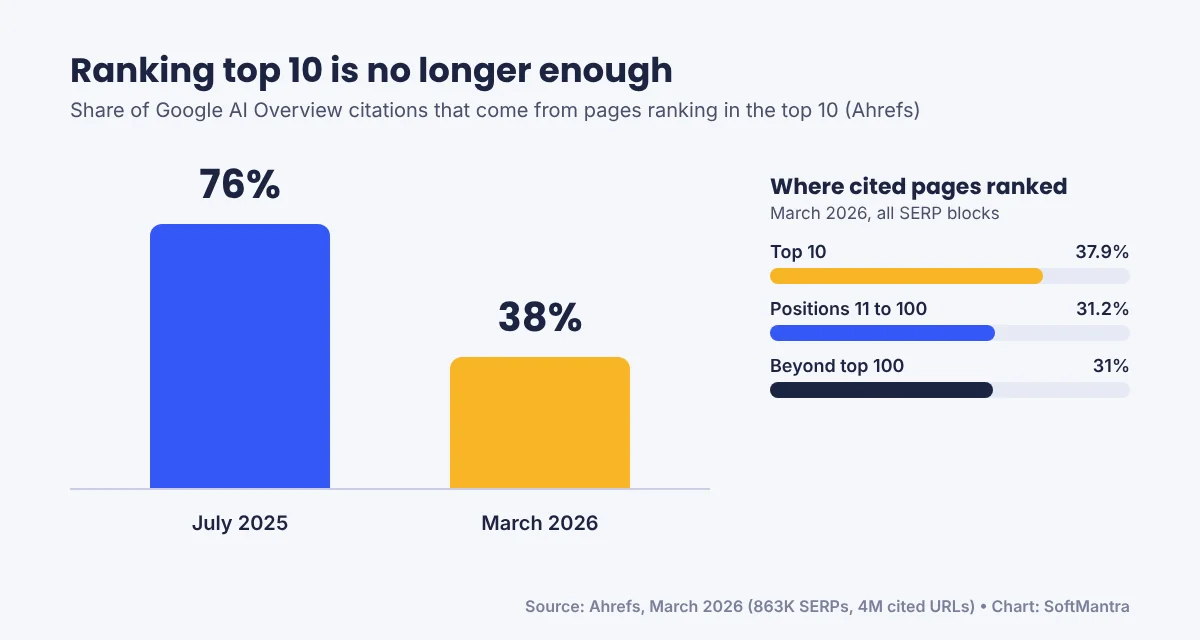
Here is a surprising finding from 2026. In a study of 863,000 search results, Ahrefs found that only 38% of the pages cited in Google AI Overviews ranked in the top 10 for that search (Ahrefs, 2026). Less than a year earlier, the figure was 76%.
In plain words, ranking on page one no longer guarantees you a place in the AI answer, and ranking lower no longer rules you out. What matters is whether your page gives Google a clear, trustworthy answer it can quote.
At SoftMantra, we now review every important client page with one question: can Google lift a clean answer from this? This checklist is the exact process we use. If you are new to the idea, start with our beginner’s guide to answer engine optimization (AEO).
Quick answer: To get cited in Google AI Overviews, make sure your page is indexed and snippet-eligible, put a clear 40 to 60 word answer right under a question-style heading, back it with lists, tables and original facts, show a named expert author and sources, and keep the page updated. Google says no special files or markup are required.
In this guide
What Are Google AI Overviews?
AI Overviews are the AI-written summaries that appear at the top of many Google results. They answer the question directly and show a few supporting links to the websites the answer was built from.
Google brought AI Overviews to India in August 2024 in English and Hindi, with a “Listen” button for audio (Free Press Journal). Today they appear on a large share of informational searches, and Google also offers a fuller chat-style version called AI Mode.
Being one of those supporting links is the new “position zero”. It puts your brand inside the answer itself, at the exact moment someone is researching.
Why Getting Cited Matters More Than Ranking
AI Overviews change how people click. Two studies show the size of the shift:
- Fewer clicks overall: Pew Research found users clicked a regular result on 8% of visits when an AI summary appeared, versus 15% without one (Pew Research Center, 2025).
- Top positions lose the most: Ahrefs measured a 58% lower click-through rate for the number one result when an AI Overview is shown (Ahrefs, 2026).
So a page that ranks first but is not cited may quietly lose traffic, while a page that is cited gets visibility even from a lower position. That is why we track citations, not just rankings.
Want to know which of your pages are already cited in AI Overviews, and which are losing clicks to them? Our AEO consulting team can map it for you.
How Google Picks Sources for AI Overviews
Google has not published a full formula, but its official guidance on AI features and recent studies give a clear picture:
Normal SEO rules still apply
Google says the same SEO best practices apply to AI features. A page must be indexed and eligible to show a snippet. There are no additional technical requirements, no special schema and no AI text files needed. Google’s 2026 AI search guide even calls AEO and GEO “still SEO”.
Google searches more than one query
AI Overviews use a method Google calls query fan-out: they run several related searches behind the scenes and combine the results. Ahrefs believes this is one reason more citations now come from pages outside the top 10 for the original query (Ahrefs). If your page answers a closely related sub-question well, it can still be cited.
Clear, specific answers win
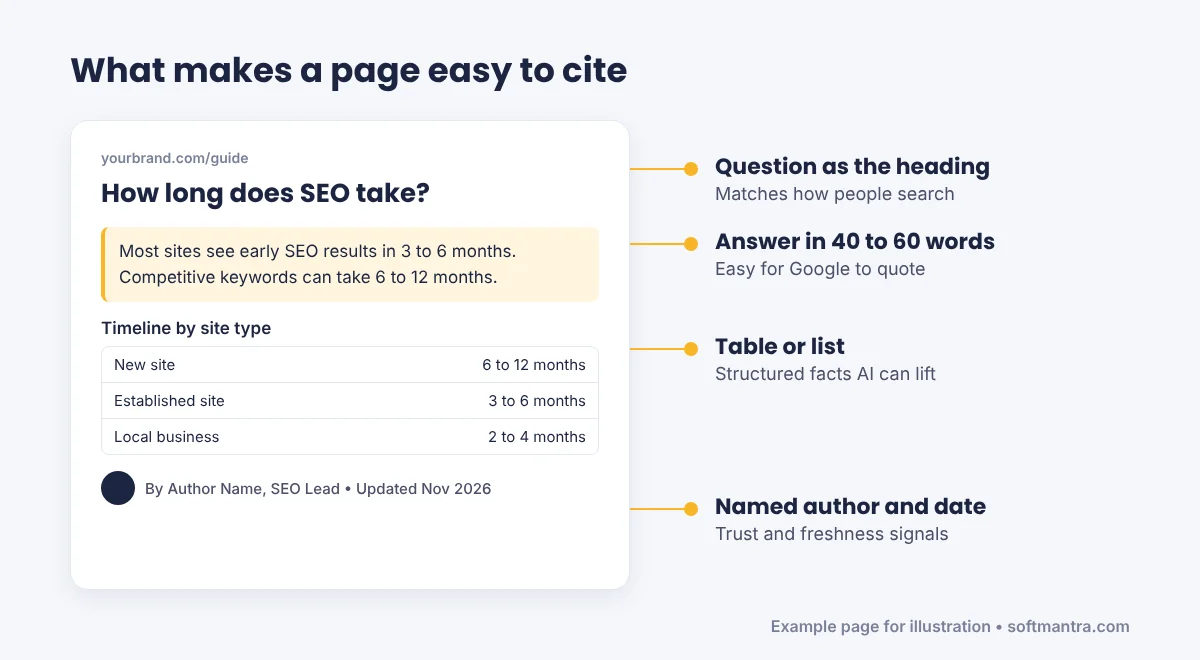
Pages that answer one question directly, with facts that are easy to lift, are much easier to cite than long, general articles. The image below shows what that looks like in practice.
Video matters too
Ahrefs reports that YouTube is now the most-cited single domain in AI Overviews (Ahrefs, 2026). For how-to topics, a short video on YouTube that matches your article can open a second route into the answer.
The 2026 AI Overviews Checklist: 14 Checks
Work through these checks for each page you want cited. Start with pages that already rank on page one or two, because they are closest to being picked.
Technical basics
- The page is indexed. Check it with the URL Inspection tool in Google Search Console.
- Snippets are allowed. Make sure there is no nosnippet, max-snippet:0 or data-nosnippet on the content you want quoted.
- The page loads fast on mobile. See our guide to Core Web Vitals in 2026 for what to fix.
- The main text is in HTML. Key answers should not be hidden inside images, PDFs or content that only loads after clicks.
Content and structure
- One clear question per section. Use the words people actually search as your H2 or H3.
- A direct answer first. Answer in 40 to 60 words right under the heading, then explain.
- Lists and tables for facts. Steps, comparisons, prices and timelines are easier to quote when structured.
- Cover related sub-questions. Because of query fan-out, a short FAQ that answers nearby questions gives Google more to work with.
- Add something original. Your own data, examples or expert opinion. Google asks for content that is not just a copy of what already exists.
Trust signals
- A named author with real experience, linked to an author page.
- Sources for every statistic, linked to the original study.
- A visible “updated” date, and real updates when facts change.
- Matching structured data such as Article, FAQ, Organization or LocalBusiness, identical to what is on the page.
- Strong internal links from related pages, so Google knows this is your main answer on the topic. Our internal linking guide explains how.
Short on time? SoftMantra’s content team can rewrite your key pages in this format, and our technical SEO team can fix the crawl and speed issues.
What Not to Do
- Do not stuff keywords or write separate thin pages for every small variation.
- Do not add FAQ schema for questions that are not on the page. Mismatched markup can be ignored or penalised.
- Do not buy “AI Overview placement”. Nobody can sell or guarantee a citation.
- Do not block snippets by accident. Some SEO plugins and themes add snippet limits that stop Google from quoting you.
- Do not publish AI text without checking it. Unverified numbers damage trust with both readers and search engines.
How to Track AI Overview Citations
Tracking AI visibility is still developing, but you have more options than a year ago:
| Method | What it shows | Notes |
|---|---|---|
| Search Console, Web search report | Clicks and impressions, including AI features | AI Overview and AI Mode traffic is counted here, but not split out |
| Search Console generative AI reports | How often your pages appear in AI features | Launched June 2026 for a first group of sites (CMSWire) |
| SEO tools with AI tracking | Which keywords trigger AI Overviews and who is cited | Ahrefs, Semrush and similar tools |
| Manual checks | Whether your brand appears for your key questions | Check monthly from an incognito window |
Look at trends over three to six months. In our WellWith case study, visibility in Google’s AI features grew 8% in three months alongside a 74% rise in clicks, which shows how SEO and AEO work together.
Google is not the only answer engine. If you also want visibility in ChatGPT and Perplexity, read ChatGPT Search vs Google Search and our guide to GEO.
Want a monthly AI visibility report for your brand? Talk to SoftMantra and we will set up tracking for your most important questions.
Frequently Asked Questions
How do I get my website into Google AI Overviews?
Make sure your page is indexed and eligible to show a snippet, answer the exact question clearly near the top, support it with structured facts like lists or tables, and show real expertise with named authors and sources. Google says there is no special markup or file needed.
Do I need to rank in the top 10 to be cited in AI Overviews?
Not always. Ahrefs found that in March 2026 only about 38% of AI Overview citations came from pages ranking in the top 10 for the query. Strong rankings still help, but a clear, specific answer can be cited even from a lower position.
Does schema markup help with AI Overviews?
Schema helps Google understand your page, but Google says no special schema is required for AI features. Use normal structured data such as Article, FAQ, Product or LocalBusiness, and make sure it matches the visible content.
Can I see AI Overview traffic in Google Search Console?
Yes, partly. Clicks and impressions from AI features are counted in the Web search performance report, and in June 2026 Google started rolling out dedicated generative AI reports that show how often your pages appear in AI features. Not every site has them yet.
Can I stop Google from using my content in AI Overviews?
You can limit it with snippet controls such as nosnippet, data-nosnippet or max-snippet. However, these also affect how your page appears in normal search results, so use them carefully.
How long does it take to get cited in AI Overviews?
If your page already ranks well and you restructure the answer, it can be picked up within weeks of being recrawled. For new topics or new sites, expect three to six months of steady content, link and authority building.
Key Takeaways
- AI Overviews cite pages that give clear, trustworthy answers. Only 38% of citations now come from top 10 pages.
- Google needs no special markup or files. The page must be indexed, snippet-eligible and genuinely helpful.
- Use question headings, short direct answers, structured facts, named authors and sources, and track citations monthly.
Start with five pages that already rank on page one or two, apply the 14 checks and review the results after a month. If you want an expert pair of eyes, our AEO consulting service is built for exactly this.
Sources
- Google Search Central: AI features and your website
- Search Engine Journal (May 2026): Google’s new AI search guide calls AEO and GEO still SEO
- Ahrefs (March 2026): Update: 38% of AI Overview citations pull from the top 10
- Ahrefs (February 2026): Update: AI Overviews reduce clicks by 58%
- Pew Research Center (July 2025): Google users are less likely to click on links when an AI summary appears
- CMSWire (June 2026): Google adds AI visibility reports to Search Console
- Free Press Journal (August 2024): Google brings AI Overviews to India