Google has changed the brain behind AI Mode. On 12 November 2026, Google brought Gemini 4 Hydrogen to Search, and it is now the default model that writes AI Mode answers.
For businesses, a model change is not just a tech story. It changes how questions are broken down, which pages get pulled in, and how answers look. In this guide we explain what Google said, what it means for SEO and GEO, and the practical steps we are taking for our own clients.
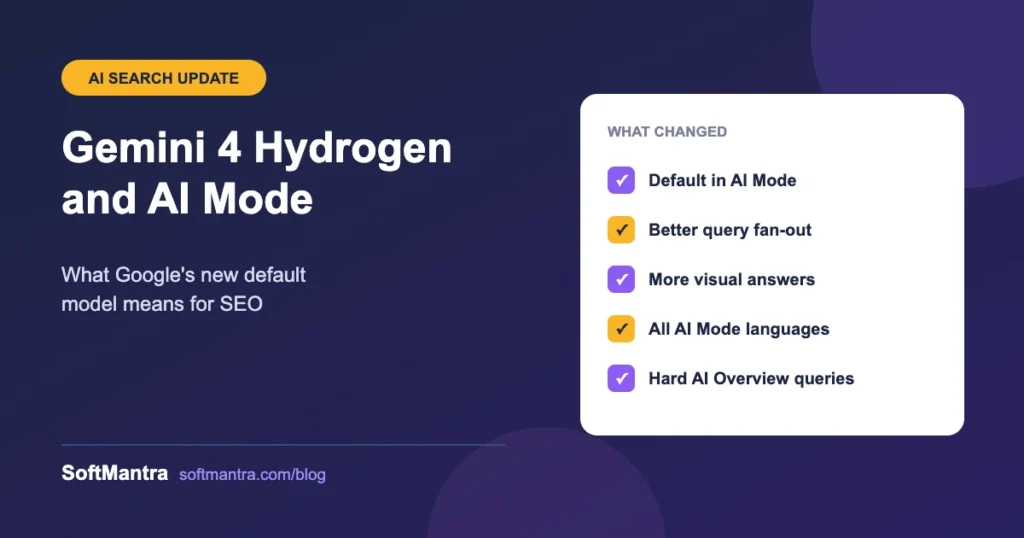
Quick answer: Gemini 4 Hydrogen is Google’s new AI model for Search. Since 12 November 2026 it is the default model in AI Mode and is also used for the hardest questions in AI Overviews. Google says it breaks down multi-part questions better, runs better query fan-out that shows more links to the web, and gives more visual answers with tables and charts.
In this guide
What Google announced on 12 November
Robby Stein, Google’s VP of Product for Search, called it “the biggest model upgrade to Search yet”. In his post on X he confirmed that Hydrogen is “now the new default model in AI Mode” and is being used for the hardest questions in AI Overviews (Relevant Audience).
According to that post, the model brings four improvements:
- It breaks down complicated, multi-part questions and follows prompts more precisely.
- Better reasoning improves query fan-out, which Google says shows more links to the web.
- Answers are more visual and scannable, with comparison tables, charts and tailored layouts.
- It understands all the languages AI Mode supports.
Google also kept a heavier model for complex work. The AI Mode menu shows “Everyday help (4 Hydrogen)” and “Most complex work (4 Carbon)”, with Carbon limited to paid subscribers (Dalin de Graff).
Four changes that matter for SEO
| Change | Why it matters for your website |
|---|---|
| Default model in AI Mode | Every AI Mode user now gets Hydrogen answers. Pages cited last month may not be cited now. |
| Used for hard AI Overview questions | Complex, multi-step queries in normal Search are also affected. |
| Better query fan-out | More sub-searches per question means more chances for niche, specific pages to be pulled in. |
| More visual answers | Pages with clean tables, specs and comparisons are easier to turn into charts and tables. |
Note one complication in your data: Google said a logging error under-reported generative AI impressions in Search Console for a few days around 9 to 11 November (DesignRush). The core update was also rolling out at the same time. So be careful when you read early numbers.
Want to know if AI Mode is citing your pages after the switch? SoftMantra’s GEO team can run a citation check for your main topics.
Query fan-out: why more sub-questions means more chances
Query fan-out is how AI Mode answers a big question. Instead of running one search, it splits your question into several smaller searches, reads results for each, and then writes one combined answer.
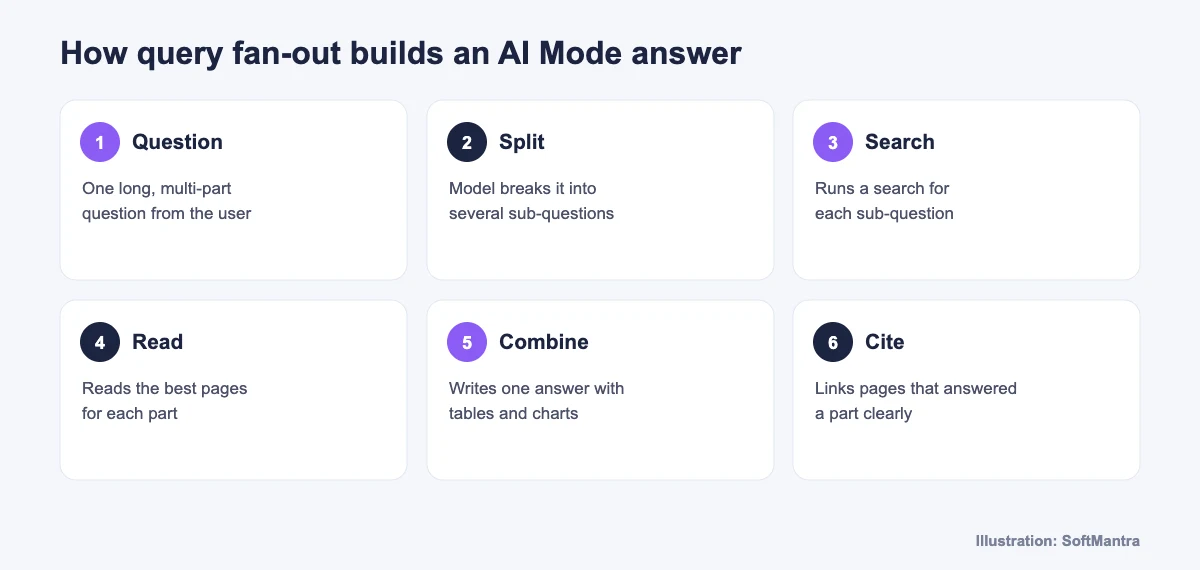
For example, a question like “best CRM for a 20 person real estate team in Noida under ₹5,000 a month” may be split into searches about CRM features for real estate, pricing in rupees, small team plans and local support. A page that clearly answers just one of those sub-questions can still be cited.
That changes content strategy. Instead of one broad page that tries to rank for a head term, you want pages and sections that answer specific sub-questions clearly. Our guide on how to get cited in Google AI Overviews covers the page structure we use.
More visual answers need structured pages
Google says Hydrogen answers use more comparison tables and charts. A model can only build a clean table if it can find clean facts. Pages that hide prices, specs or steps in long paragraphs are harder to use.
- Put key facts in HTML tables: prices, plans, features, timings, sizes.
- Use clear H2 and H3 headings phrased the way people ask questions.
- Give a short, direct answer right under each heading, then the detail.
- Add relevant schema markup such as Product, LocalBusiness, FAQPage or HowTo where it fits the visible content.
- Keep numbers consistent across your site, Google Business Profile and other listings.
What this means for Indian businesses
Google says Hydrogen has a rich understanding of all languages AI Mode supports. India is a multilingual market, so this matters. Many people mix Hindi and English in one query. If your audience searches in Hindi or Hinglish, consider good quality Hindi pages for your main services, written by people, not machine translated.
AI Mode is also getting more personal. Google announced that AI Mode can now draw on Google Drive and Google Wallet for more personalised answers (TechCrunch). Personal context means two users may see different answers to the same question, so tracking single rankings becomes less meaningful.
For a deeper India focused view, read our guide to Google AI Mode SEO in India.
Need content built for AI Mode and AI Overviews? Explore SoftMantra’s AEO consulting.
A 30 day action plan
- Week 1: Baseline. Pick 20 questions your customers ask. Search each in AI Mode and note which sites are cited.
- Week 2: Gap list. For each question, list the sub-questions in the answer. Mark the ones your site does not answer.
- Week 3: Fix pages. Add short answer blocks, tables and FAQs to your best pages. Update old facts.
- Week 4: Re-check. Search the same 20 questions again. Record changes in citations, not just rankings.
If you are new to this, start with our explainer on what answer engine optimization is.
How to measure it
Google reports AI Mode and AI Overview traffic inside normal Search Console Performance data. Google also says there is no special file or markup needed to appear in AI features; normal SEO best practices apply (Google Search Central).
- Track clicks and impressions for question-style queries in Search Console.
- Keep a simple sheet of AI Mode citations for your 20 key questions, checked monthly.
- Watch branded search and direct traffic. People who see you in AI answers often search for you by name later.
Want a monthly AI visibility report for your brand? Contact SoftMantra and we will set it up.
Frequently Asked Questions
What is Gemini 4 Hydrogen?
Gemini 4 Hydrogen is a Google AI model launched in Search on 12 November 2026. It is the default model in AI Mode and also handles the hardest questions in AI Overviews.
Is Gemini 4 Hydrogen free to use?
Yes, in Google Search it is available to all users through AI Mode. A heavier model, Gemini 4 Carbon, is offered for complex work to paid subscribers.
What is query fan-out?
Query fan-out is when AI Mode splits one question into several smaller searches, reads results for each, and combines them into one answer with links.
Do I need special markup for AI Mode?
No. Google says no special file or schema is needed for AI features. Clear content, good structure and normal SEO best practices apply.
Will my AI Mode citations change after this update?
They can. A new model may pick different pages. Re-check your key questions in AI Mode and compare with your earlier citations.
Should Indian businesses create Hindi content for AI Mode?
If your customers search in Hindi or Hinglish, well written Hindi pages for main services can help, since Google says the model understands all AI Mode languages.
Sources
- Robby Stein on X: Gemini 4 Hydrogen announcement thread
- Relevant Audience: Gemini 4 Hydrogen reaches Google Search for all users
- Dalin de Graff: Google swapped the model behind AI Mode
- DesignRush: Core update, AI report gap and Gemini 4 Hydrogen roundup
- TechCrunch: Google Search’s AI Mode can now tap into Drive and Wallet
- Google Search Central: AI features and your website