
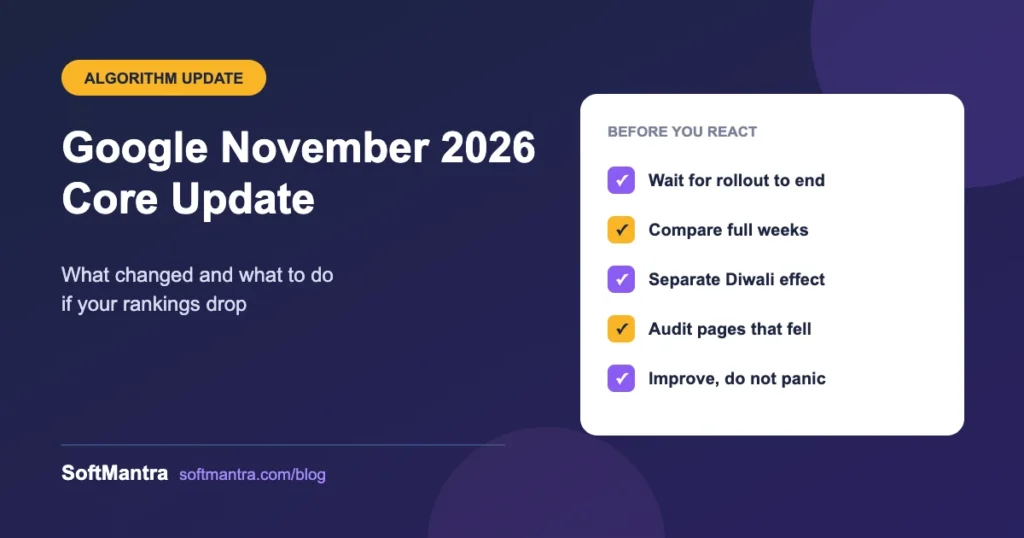
If your Google traffic looked strange over the last two weeks, you are not alone. Google started rolling out the November 2026 core update on 10 November, and rankings have been moving across many industries since then.
Most site owners make the same mistake during a core update: they panic, rewrite pages and change titles while the rollout is still running. That makes the data even harder to read. In this guide we explain what Google has actually confirmed, how to tell a real drop from noise, and what to do if your rankings fall.
Quick answer: The November 2026 core update is a broad change to Google’s ranking systems. It started on 10 November 2026 at 10:06 a.m. Pacific time, applies to all countries and languages, and may take up to two weeks to finish. Google says to wait until the rollout ends, then compare a full week of Search Console data with the week before it began.
In this guide
What Google released and when
Google logged the update on its Search Status Dashboard with one line: it “applies globally and to all languages” and the rollout “may take up to 2 weeks to complete” (Google Search Status Dashboard). The rollout began at 10:06 a.m. Pacific time on 10 November, which was late night on 10 November in India (Search Engine Journal).
On LinkedIn, Google Search Central described it as “a regular update designed to better surface relevant, satisfying content for searchers from all types of sites” (Search Engine Roundtable). Unusually, Google posted this on LinkedIn and not on its X account (Rank Math).
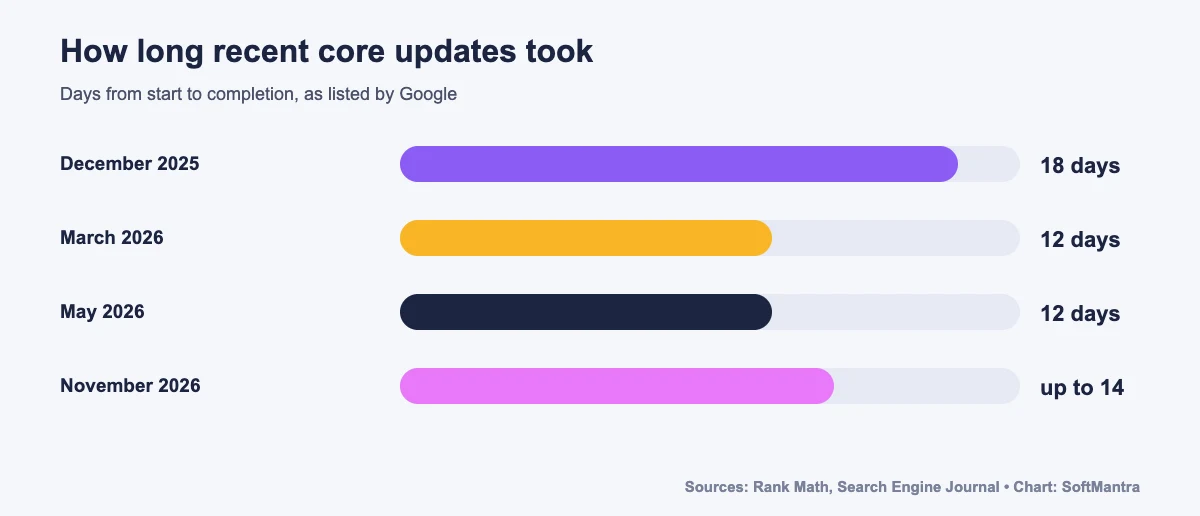
This is the third core update of 2026. The March update ran from 27 March to 8 April and the May update ran from 21 May to 2 June (Search Engine Journal). If the November update follows the same pattern, it should finish around 24 November.
What Google did not say
Google did not name any type of site, niche or signal. Google’s documentation says core updates do not target specific pages or sites; they are meant to improve how its systems assess content overall (Google Search Central). So if someone tells you “this update targeted agency blogs” or “this update killed AI content”, treat that as opinion, not fact.
Why this update is hard to read in India
For Indian businesses, the timing makes the data messy. Several other things changed in the same two weeks:
- Diwali week. Diwali fell on 8 November 2026, two days before the rollout began. Search demand for many retail, gifting and travel terms peaks and then falls around the festival, with or without an algorithm change.
- A new AI Mode model. On 12 November, Google made Gemini 4 Hydrogen the default model in AI Mode (DesignRush). That can change which pages get cited in AI answers.
- A Search Console reporting gap. Google said a logging error under-reported generative AI impressions in Search Console for a few days around 9 to 11 November (DesignRush).
- Black Friday is close. The week after the rollout includes Black Friday and Cyber Monday, so retail data will be unusual again (Search Engine Journal).
This is why a simple “last 7 days vs previous 7 days” view in Search Console can mislead you right now.
Not sure whether your drop is the update or the festival season? Ask SoftMantra for a quick core update check. We will tell you honestly if anything needs fixing.
What not to do while it rolls out
Google’s advice is simple: let the rollout finish before you judge it. Until then, avoid these reactions:
- Do not rewrite or delete pages that dropped a few positions in the first week. Rankings often bounce during a rollout.
- Do not change URLs or run a site migration. Redirect changes add new noise on top of the update.
- Do not buy links or “recovery packages”. Google’s spam policies still apply, and paid links can make things worse.
- Do not mass-produce new AI pages to “make up” traffic. Thin pages tend to hurt overall site quality.
You can still fix clear technical problems at any time, such as broken pages, server errors or an accidental noindex tag.
How to check if you were really hit
Once Google marks the update as complete on the dashboard, follow Google’s own method. Wait at least one full week after completion, then compare that week with the week before the rollout began (Search Engine Journal summarising Google’s documentation).
- Open Search Console, go to Performance, and choose Compare. Pick the week before 10 November and one full week after completion.
- Look at clicks and average position at the page level, not only the site total.
- Check the Queries tab for the top pages that lost clicks. Did they lose position, or did fewer people search?
- Compare with the same period last year. If last year also dropped after Diwali, part of your drop is seasonal.
If you track many keywords, our Google algorithm updates timeline and impact tracker helps you line up past updates with your own traffic history.
Common drop patterns and what they usually mean
Here is how we usually read drops after a core update. These are patterns from experience, not rules from Google.
| What you see | Likely meaning | What to do first |
|---|---|---|
| Whole site down by a similar percentage | Google reassessed overall site quality or relevance | Review your weakest, thinnest pages and site-wide trust signals |
| A few key pages down, rest stable | Competing pages now answer that query better | Compare your page with the new top 3 for the same query |
| Impressions stable, clicks down | More AI answers or ads above your result, or a weaker snippet | Improve title and description, check AI Overview presence |
| Impressions and clicks down for festival terms only | Seasonal demand, not the update | Compare with the same weeks last year |
| Drop started before 10 November | Another cause, such as a technical issue or the September spam update | Run a technical audit and check Manual Actions |
A recovery plan that matches Google’s advice
Google says there may be nothing to “fix” after a core update, and that improvements can take time to show, sometimes until the next core update (Google Search Central). Still, if your pages lost ground, these steps line up with Google’s guidance on helpful content (Google Search Central):
- Audit the pages that dropped. Ask honestly: does this page give original information, or does it repeat what ten other sites say?
- Add real experience. Show who wrote it, what they have done, and include your own data, photos, examples or process. Our E-E-A-T guide explains the signals.
- Merge or remove weak pages. Several thin pages on the same topic often do worse than one strong page. Merge them with a 301 redirect.
- Fix technical basics. Slow pages, duplicate URLs and crawl errors drag down good content. Use our technical SEO audit checklist.
- Update facts and dates. Outdated statistics and old screenshots reduce trust.
- Earn mentions. Real links and brand mentions from relevant sites still matter for authority.
Want a second pair of eyes on the pages that dropped? Our SEO team runs page-level reviews based on Google’s own quality questions.
What this means for AI search visibility
Google uses its core ranking systems for AI Overviews and AI Mode as well, and says the same SEO best practices apply to both (Google Search Central). In practice, a page that loses trust in normal rankings often appears less in AI answers too.
That is why we look at both together. If you want to understand how AI Mode works in India and how pages get chosen for its answers, read our guide on Google AI Mode SEO for India. Clear answers, good structure and real expertise help in both places.
Core update recovery is slow work, but it is not guesswork. Talk to SoftMantra if you want a plan built on your own Search Console data.
Frequently Asked Questions
When did the Google November 2026 core update start?
It started on 10 November 2026 at 10:06 a.m. Pacific time, according to the Google Search Status Dashboard. Google said the rollout may take up to two weeks.
Is the November 2026 core update finished?
Check the Google Search Status Dashboard. Google adds a completion note there when the rollout ends. Based on the two week estimate, it was expected to finish around 24 November.
My traffic dropped after Diwali. Is it the core update?
Not always. Diwali fell on 8 November 2026, just before the rollout began, so seasonal demand changes overlap with the update. Compare with the same weeks last year before deciding.
How long does it take to recover from a core update?
Google says improvements can take time and may not show until the next core update. Steady work on content quality, experience and technical health is the reliable path.
Should I delete pages that lost rankings?
Not immediately. First check if the page is thin or outdated. Improve it, or merge it into a stronger page with a 301 redirect. Delete only pages with no value to users.
Does the core update affect AI Overviews?
Google uses its core ranking systems for AI features too, so pages that lose trust in normal results may also appear less in AI Overviews and AI Mode.
Sources
- Google Search Status Dashboard: November 2026 core update
- Google Search Central: Google Search core updates and your website
- Google Search Central: Creating helpful, reliable, people-first content
- Search Engine Journal: Google’s November 2026 Core Update Starts Rolling Out
- Search Engine Roundtable: Google November 2026 Core Update Is Rolling Out
- Rank Math: November 2026 Core Update
- DesignRush: Core update, AI report gap and Gemini 4 Hydrogen roundup
- Google Search Central: AI features and your website