Search “SoftMantra” and Google needs to decide which SoftMantra you mean. There may be several businesses, people or products with similar names. The brands that get shown correctly, in knowledge panels and in AI answers, are the ones that search engines can identify with confidence.
That is what entity SEO is about. It is less about keywords and more about making your brand a clear, well-connected “thing” that Google and AI assistants understand.
Quick answer: Entity SEO is the practice of helping search engines and AI systems recognise your brand, people and products as distinct entities and link the right facts to them. Do it by describing your brand clearly on your website, adding Organization and Person schema with sameAs links, keeping your name, address and profiles consistent everywhere, and earning genuine mentions on trusted sites.
In this guide
What Is an Entity?
An entity is a distinct thing that can be identified: a company, a person, a place, a product or a concept. Your business is an entity. So is your founder, your office location and your flagship product. Search engines store facts about entities and the relationships between them, such as “Akansha Gupta is the founder of SoftMantra”.
Why Entities Matter for Google and AI
- Disambiguation: Google needs to tell your brand apart from others with similar names.
- Knowledge panels: confident entity understanding can lead to a brand panel in search results.
- AI answers: AI assistants can only recommend a brand they recognise and can describe accurately.
- Trust: clear facts about who runs a business support E-E-A-T. See our E-E-A-T guide.
If you are working on GEO, entity clarity is one of the foundations.
Want your brand described correctly in Google and AI answers? Our GEO consulting starts with an entity audit.
Define Your Brand on Your Own Site
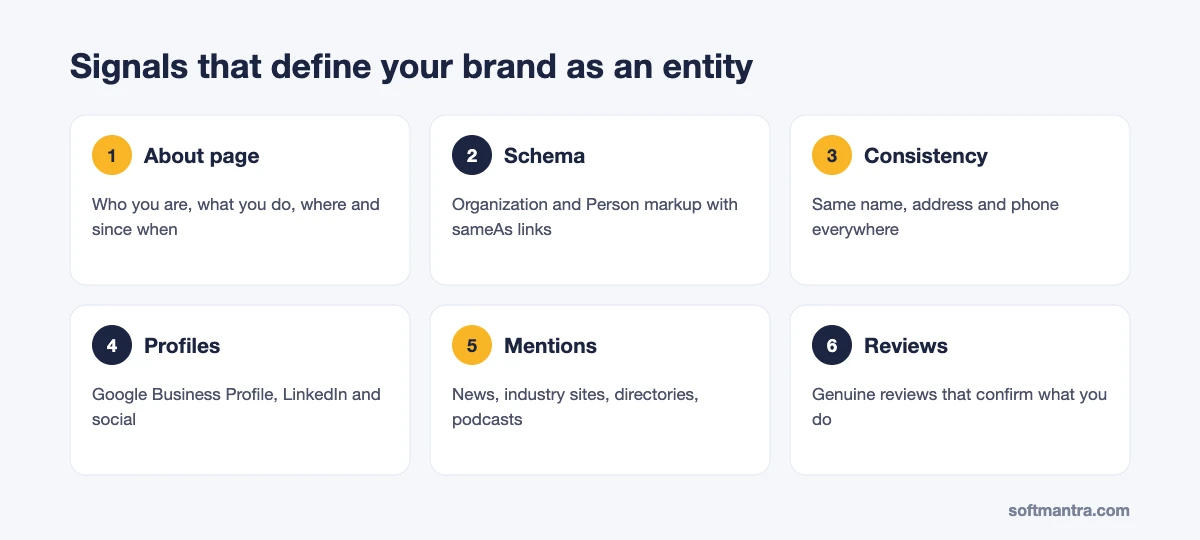
- A strong About page stating who you are, what you do, where you are based, when you were founded and who leads the company.
- Author and founder pages with qualifications and links to their professional profiles, like our founder page.
- Consistent naming: use the same brand name everywhere, not three variations.
- Clear service pages that link back to the About page.
Use Organization and Person Schema
Google says adding Organization structured data to your home page can help it understand your organization’s administrative details and disambiguate your organization in search results (Google). Since 2023, Google can use this markup in knowledge panels and other visual elements (Google).
{
  "@context": "https://schema.org",
  "@type": "Organization",
  "name": "Your Brand",
  "url": "https://www.yourbrand.com",
  "logo": "https://www.yourbrand.com/logo.png",
  "foundingDate": "2015",
  "founder": { "@type": "Person", "name": "Founder Name" },
  "sameAs": [
    "https://www.linkedin.com/company/yourbrand",
    "https://www.facebook.com/yourbrand"
  ]
}- Use sameAs to list your official profiles on other sites.
- Add Person schema on founder and author pages.
- Keep markup consistent with what is visible on the page. Our schema guide covers the rules.
Keep Your Details Consistent Everywhere
Search engines compare what different sources say about you. If your website, Google Business Profile, LinkedIn page and directories show different names, addresses or phone numbers, your entity becomes less clear. Google’s Business Profile guidelines also require your business to be represented accurately (Google).
| Detail | Keep identical on |
|---|---|
| Brand name | Website, Google Business Profile, LinkedIn, social profiles, directories |
| Address and phone | Website footer, contact page, Business Profile, citations |
| Founder and leadership | About page, LinkedIn, press mentions |
| Description | Website, LinkedIn About, social bios, directory listings |
Earn Mentions That Confirm Who You Are
- Get featured in industry publications and local news.
- Speak at events, join podcasts and write expert articles.
- Get listed in respected directories and associations.
- Encourage genuine reviews on Google and industry platforms.
Each mention that repeats the same facts about your brand strengthens the connection. Our digital PR guide explains how to earn them.
How to Check Your Entity Strength
- Search your brand name. Do you see a knowledge panel, and is it correct?
- Ask ChatGPT, Gemini and Perplexity “What is [your brand]?” and check the facts.
- Test your home page with Google’s Rich Results Test to confirm Organization markup is valid.
- Compare your name, address and phone across your top 10 listings.
Our guide to tracking AI search visibility shows how to log these checks each month.
Want a full entity and brand audit? Talk to SoftMantra and we will show you what Google and AI currently know about your brand.
Key Takeaways
- Entity SEO makes your brand a clear, recognisable thing for Google and AI.
- Use a strong About page, Organization and Person schema with sameAs, and consistent details everywhere.
- Genuine mentions on trusted sites confirm who you are and help AI recommend you.
Frequently Asked Questions
What is entity SEO in simple words?
It means making it easy for search engines and AI systems to recognise your brand, people and products as clear, distinct things, and to connect the right facts to them.
Do I need a Wikipedia page for entity SEO?
No. A Wikipedia page can help well-known brands, but most businesses build strong entity signals through their own website, schema, consistent profiles and genuine mentions.
Does Organization schema guarantee a knowledge panel?
No. Google says Organization markup helps it understand and disambiguate your organization, and can be used in knowledge panels, but nothing guarantees one.
How is entity SEO related to GEO?
AI assistants recommend brands they can identify confidently. Clear entity signals make it more likely that ChatGPT, Gemini and Google AI describe your brand correctly.