“Should we run Google Ads or Facebook and Instagram ads?” is one of the most common questions we hear from small business owners in India. Both platforms can bring customers. Both can also burn money quickly if you choose the wrong one for your business.
This guide compares the two honestly, based on how we plan PPC campaigns for clients at SoftMantra, so you can decide where your first rupee should go.
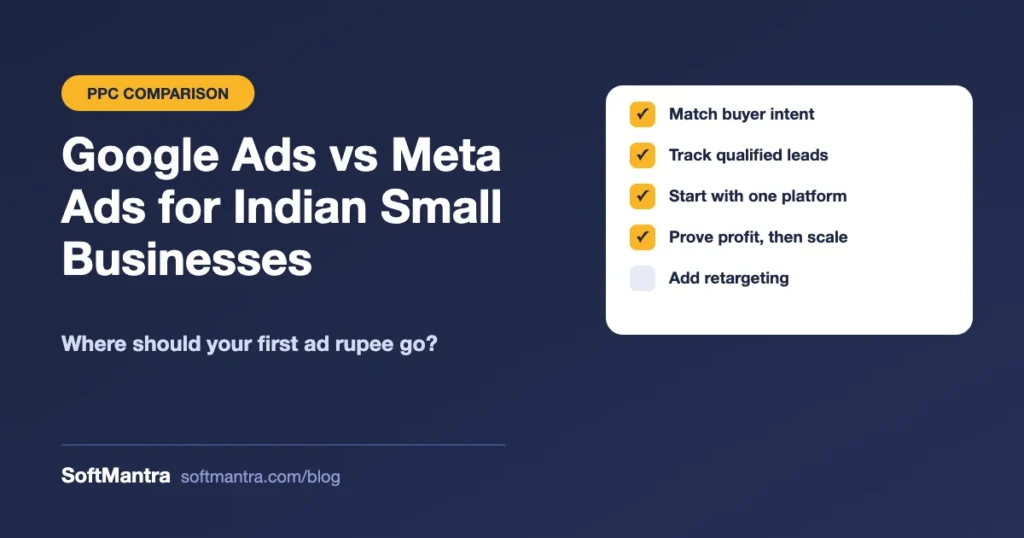
Quick answer: Google Ads captures people who are already searching for what you sell, so it suits services, urgent needs and high-intent purchases. Meta Ads (Facebook and Instagram) reaches people based on interests and behaviour, so it suits visual products, new offers and building demand. Most small businesses should start with the platform that matches their buyer’s intent, prove a profitable cost per lead, then add the other.
In this guide
The Core Difference: Intent vs Interest
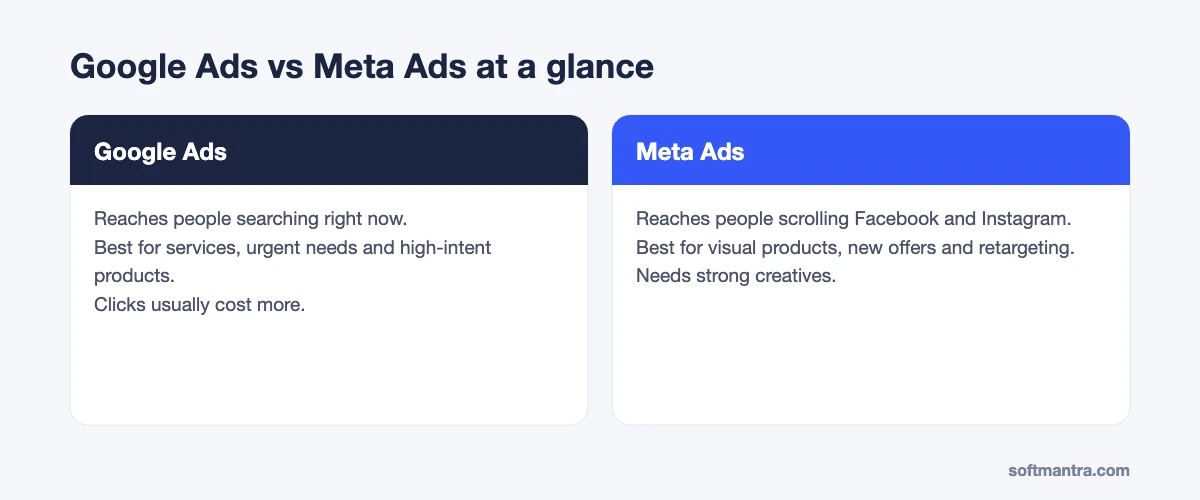
Google Ads shows your ad when someone searches for a keyword, such as “CA firm in Noida” or “buy running shoes online”. The person already has a need. Meta Ads shows your ad while people scroll Facebook or Instagram. They were not looking for you, so the ad must catch attention and create interest.
When Google Ads Works Best
- Service businesses with clear search demand: plumbers, clinics, coaching centres, CA and legal firms.
- Urgent needs, where people search and call within minutes.
- B2B services where buyers research by keyword.
- E-commerce products people search by name, using Google Shopping ads.
Google also matters because search behaviour in India keeps expanding into voice and images; Google says India is its largest user base for voice and visual search globally (Google India).
Want Google Search ads that bring calls, not just clicks? Our search advertising team sets up campaigns around high-intent keywords.
When Meta Ads Works Best
- Visual products such as fashion, beauty, home decor and food.
- New products or offers that people do not search for yet.
- Local promotions to people in a specific area or pin code radius.
- Lead generation with instant forms for education, real estate and events.
- Retargeting people who visited your website but did not enquire.
Reach is huge: DataReportal estimates India had 573 million social media user identities in October 2026 (DataReportal).
Side by Side Comparison
| Factor | Google Ads | Meta Ads |
|---|---|---|
| User intent | High: actively searching | Lower: browsing and discovering |
| Targeting | Keywords, location, audiences | Interests, demographics, location, lookalikes |
| Creative needed | Short text ads, landing page | Strong images, reels and videos |
| Cost per click | Usually higher | Usually lower |
| Lead quality | Usually warmer | Varies; needs good qualification |
| Best for | Capturing existing demand | Creating new demand and retargeting |
Which platform first? Examples by business type
Here is how we usually advise clients on where to start. Your own numbers should decide what happens next.
| Business | Start with | Why |
|---|---|---|
| Dental or skin clinic | Google Search, then Meta | Patients search for treatments near them; Meta helps with offers and retargeting |
| Coaching institute | Meta lead ads and Google Search | Parents and students respond to both visual offers and course searches |
| Home services (AC repair, pest control) | Google Search | Needs are urgent and people call the first good result |
| D2C fashion or beauty brand | Meta | Products sell visually through reels and carousel ads |
| B2B software or services | Google Search, then LinkedIn | Buyers research by problem and solution keywords |
| Restaurant or cafe | Meta and Google Business Profile | Food sells visually, and local searches drive walk-ins |
Notice that most businesses end up using both platforms. The difference is the order, and how much budget each gets once you know your cost per qualified lead.
One more tip: whatever you choose, the page after the click decides your results. A fast, focused landing page with one clear call to action, a phone button and trust signals often cuts cost per lead more than any bidding change. Our web development team builds landing pages for exactly this reason.
How to Split a Small Budget
- Start with one platform that matches how your customers buy.
- Run it for at least four to six weeks with clear tracking.
- Find your cost per qualified lead and your break-even cost.
- Once profitable, add the second platform, often starting with retargeting.
- Review weekly: pause losing ads, refresh creatives, scale what works.
Not sure how much to spend? See our PPC packages or our Facebook ads management service.
Track Leads, Not Clicks
- Set up conversion tracking for form submissions, calls and WhatsApp clicks before spending.
- Ask every new lead how they found you.
- Mark junk leads in your CRM and calculate cost per qualified lead.
- Send good leads back to the platform where possible so its AI optimises for quality.
Common Mistakes
- Splitting a tiny budget across both platforms from day one.
- Sending ad traffic to the home page instead of a focused landing page.
- Judging Meta and Google only by cost per click.
- Running the same creative for months until it stops working.
- Ignoring SEO: ads are rented traffic, while SEO builds an asset you own.
Want a second opinion on your ad spend? Contact SoftMantra for a free PPC audit.
Key Takeaways
- Google Ads captures intent; Meta Ads creates interest.
- Choose the platform that matches how your customers buy, then prove profit before adding the second.
- Measure cost per qualified lead, not cost per click.
Frequently Asked Questions
Is Google Ads more expensive than Meta Ads?
Clicks on Google Search usually cost more than clicks on Facebook or Instagram, but searchers have higher intent. Compare cost per qualified lead or sale, not cost per click.
Which is better for a new local business?
If people already search for your service, such as “AC repair near me”, start with Google Search ads. If you sell something people discover visually, start with Meta.
Can I run both together?
Yes, once one channel is profitable. Many businesses use Google to capture demand and Meta to create demand and retarget visitors.
How much should a small business spend to start?
Enough to collect meaningful data on one channel for at least four to six weeks. Splitting a very small budget across many campaigns usually gives unclear results.