
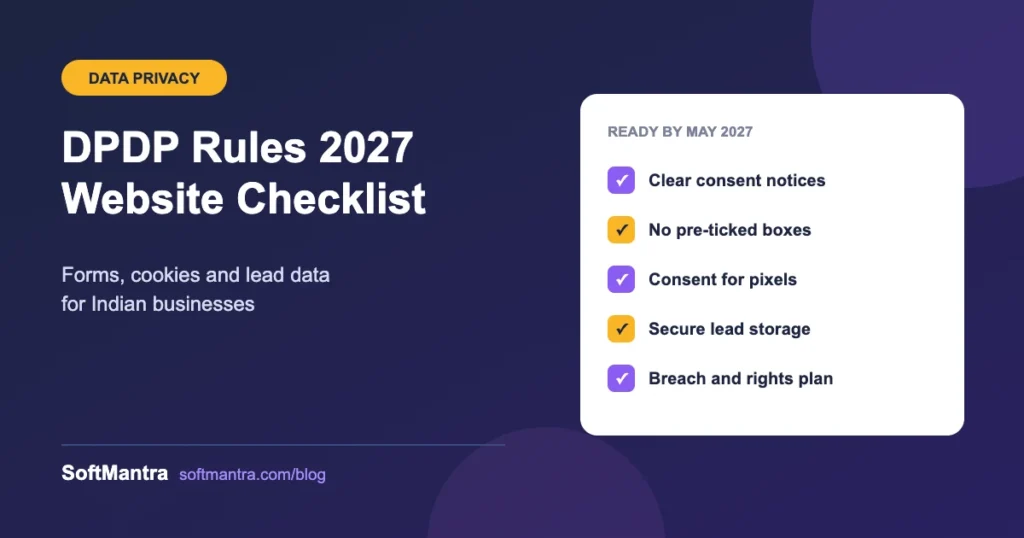
Every enquiry form on your website collects personal data: a name, a phone number, an email. Under India’s Digital Personal Data Protection (DPDP) Act and the DPDP Rules, 2025, how you collect and use that data now has clear legal duties.
The main obligations apply from May 2027, which sounds far away. It is not. Website changes, CRM clean-ups and vendor contracts take months. This checklist covers what a typical business website should fix, especially lead forms, tracking and lead data.
Note: This is a practical marketing and website checklist, not legal advice. Please confirm your obligations with a qualified lawyer.
Quick answer: The DPDP Rules, 2025 were notified in November 2025 with an 18 month phased rollout. Core duties such as clear consent notices, security safeguards, breach reporting and data rights apply from around mid May 2027. Websites should update forms, privacy notices, tracking consent and lead data handling before then.
In this guide
The DPDP timeline in plain words
The government notified the DPDP Rules on 14 November 2025 after consultations that received 6,915 inputs (PIB). The rules come in three phases (Storyboard18):
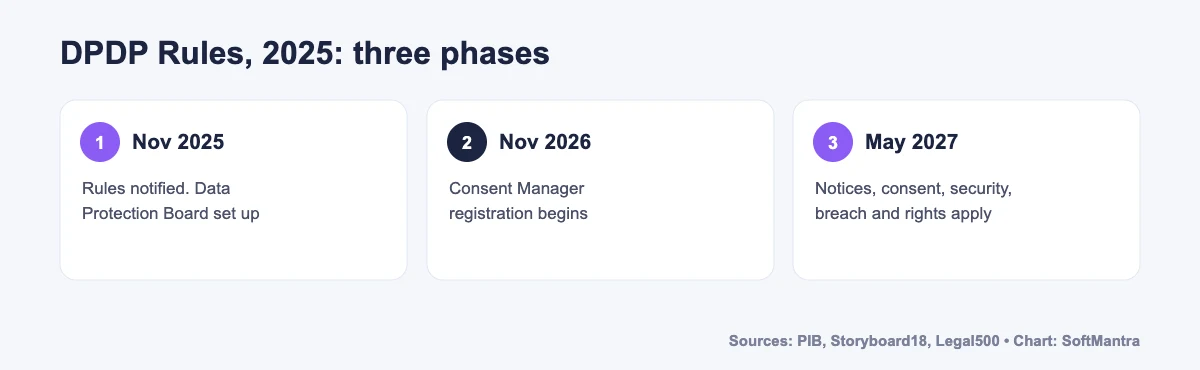
- Immediately (November 2025): rules on the Data Protection Board.
- After 12 months (November 2026): registration of Consent Managers. This phase has now started.
- After 18 months (around 13 May 2027): the core rules on notices, consent, security, breach reporting, retention and rights (Legal500).
Does it apply to your website?
If your website collects digital personal data of people in India, you are likely a “Data Fiduciary” under the Act. That includes contact forms, quote requests, newsletter sign-ups, WhatsApp click-to-chat, job applications and checkout pages.
Size does not create an exemption by default. A small clinic, coaching centre or agency collecting enquiries online has duties too. Larger platforms may be named “Significant Data Fiduciaries”, who must also run independent audits and impact assessments (PIB).
Checklist: contact and lead forms
Forms are where most websites collect personal data. PIB’s summary says notices must be clear and easy to understand and explain the specific purpose of collection, and that people can withdraw consent at any time (PIB).
- Add a short notice next to each form: what you collect, why, and a link to your privacy notice.
- Use a consent checkbox that is not pre-ticked for anything beyond answering the enquiry, such as marketing messages.
- Ask only for data you need. Do you really need date of birth or full address on a contact form?
- Keep separate consent for separate purposes, for example “reply to my enquiry” and “send me offers on WhatsApp”.
- Explain how to withdraw consent, for example an email address or an unsubscribe link.
- If a form may be used by children, such as schools or coaching, plan for verifiable parental consent (PIB).
Need your forms and privacy notice updated? SoftMantra’s website team can rebuild forms with proper consent fields.
Checklist: cookies, pixels and tracking
The DPDP Rules do not include a separate cookie rule like Europe’s. But tracking tools such as analytics, ad pixels and session recording can collect personal data. In our reading, the safest approach is to treat them under the same consent principles. Confirm this with your lawyer.
- List every tag on your site: GA4, Google Ads, Meta Pixel, LinkedIn, Hotjar, chat widgets.
- Load marketing and advertising tags only after the visitor agrees, using a consent banner.
- Make “Reject” as easy as “Accept”.
- Avoid sending form data such as phone numbers or emails into analytics or ad pixels in plain text.
- Review which third parties receive data and update your privacy notice to name them.
A clean technical audit is a good time to review all tags, because unused scripts also slow down your site.
Checklist: storing and using lead data
Leads often end up in many places: email inboxes, Google Sheets, CRMs, WhatsApp, and agency dashboards. Each copy is a risk.
| Area | What to check |
|---|---|
| Storage | Where every lead is stored, and who can access it |
| Retention | How long you keep leads that never converted, and when you delete them |
| Vendors | Contracts with CRM, form, email and ad tools that process data for you |
| Security | Strong passwords, two factor login, no shared accounts, access logs |
| Ad audiences | Customer lists uploaded to Google or Meta must match consent given |
PIB says the highest penalty, up to ₹250 crore, applies to failing to maintain reasonable security safeguards (PIB). For most businesses, this is the section that needs the most work.
Running lead ads? Our PPC team can audit how lead data flows from ads to your CRM.
Checklist: breaches, rights and grievances
- Breach plan. If a breach happens, affected people must be informed without delay with what happened, the likely impact and steps taken (PIB). The Data Protection Board must also be informed. Write a simple plan now.
- Rights requests. People can ask to access, correct, update or erase their data. These must be handled within a maximum of 90 days (PIB).
- Contact point. Publish an email or form for privacy requests and grievances.
- Records. Keep proof of consent: what notice was shown and when the person agreed.
Penalties and why to start now
PIB lists three penalty levels (PIB):
- Up to ₹250 crore for failing to keep reasonable security safeguards.
- Up to ₹200 crore for failing to report a breach, or for breaking child data rules.
- Up to ₹50 crore for other violations.
Most of the work is practical, not legal: better forms, fewer tags, cleaner CRM habits. Starting in early 2027 is risky because website and vendor changes take time. The 18 month period was given so businesses could adjust their systems in phases (AZB and Partners).
Want a DPDP readiness review of your website forms and tracking? Contact SoftMantra. We work alongside your legal adviser.
Frequently Asked Questions
When do the DPDP Rules apply to websites?
The core duties on notices, consent, security, breach reporting and rights apply 18 months after notification, around mid May 2027. Some rules already apply.
Does DPDP apply to small businesses?
Generally yes, if you collect digital personal data of people in India, such as names and phone numbers through website forms. Check exemptions with a lawyer.
Do I need a cookie banner under DPDP?
DPDP has no separate cookie rule, but tracking tools can collect personal data. A consent banner for marketing tags is a sensible approach. Confirm with your legal adviser.
What is the maximum DPDP penalty?
Up to ₹250 crore for failing to maintain reasonable security safeguards, according to PIB. Other violations carry penalties up to ₹200 crore or ₹50 crore.
How fast must I respond to a data deletion request?
PIB says requests to access, correct, update or erase data must be addressed within a maximum of 90 days.
What is a Consent Manager?
A registered India based company that offers a single platform where people can give, manage, review or withdraw consent. Registration started 12 months after the Rules were notified.